How to Choose the Right Dog Trainer for Your Pet
Finding the right dog trainer can transform your relationship with your pet. Here's what to look for, what to avoid, and how to tell if a trainer is truly qualified.

A good dog trainer doesn't just teach your dog to sit. They change the way you communicate with your pet, solve behavior problems at the root, and give you tools that last a lifetime. A bad one can set your dog back months — or worse, create new fear and anxiety.
The difference between the two isn't always obvious from a website or a Yelp rating. Here's how to evaluate trainers like a professional so you find the right fit the first time.
What to Look for in a Dog Trainer
Credentials That Actually Matter
Dog training is an unregulated industry. Anyone can call themselves a trainer tomorrow. That makes credentials your first filter — not because a certificate guarantees greatness, but because it shows a baseline commitment to learning the science.
Look for these certifications:
- CPDT-KA (Certified Professional Dog Trainer – Knowledge Assessed) — Requires 300+ hours of hands-on training experience and a rigorous exam covering learning theory, ethology, and husbandry. This is the gold standard for pet dog trainers.
- CAAB (Certified Applied Animal Behaviorist) — An advanced credential for behavior cases. Requires a master's or doctorate in animal behavior.
- KPA CTP (Karen Pryor Academy Certified Training Partner) — A well-respected program focused on clicker training and positive reinforcement methods.
- IAABC Certified (International Association of Animal Behavior Consultants) — Good for behavior consultants handling aggression, anxiety, and phobias.
Red flag certifications: Be cautious of credentials from organizations that promote or endorse aversive methods (shock collars, prong collars, alpha rolls). Some certifications are pay-to-play with no real evaluation.
Training Philosophy
This is the most important factor. A trainer's philosophy determines every interaction they'll have with your dog.
Science-based, positive reinforcement trainers:
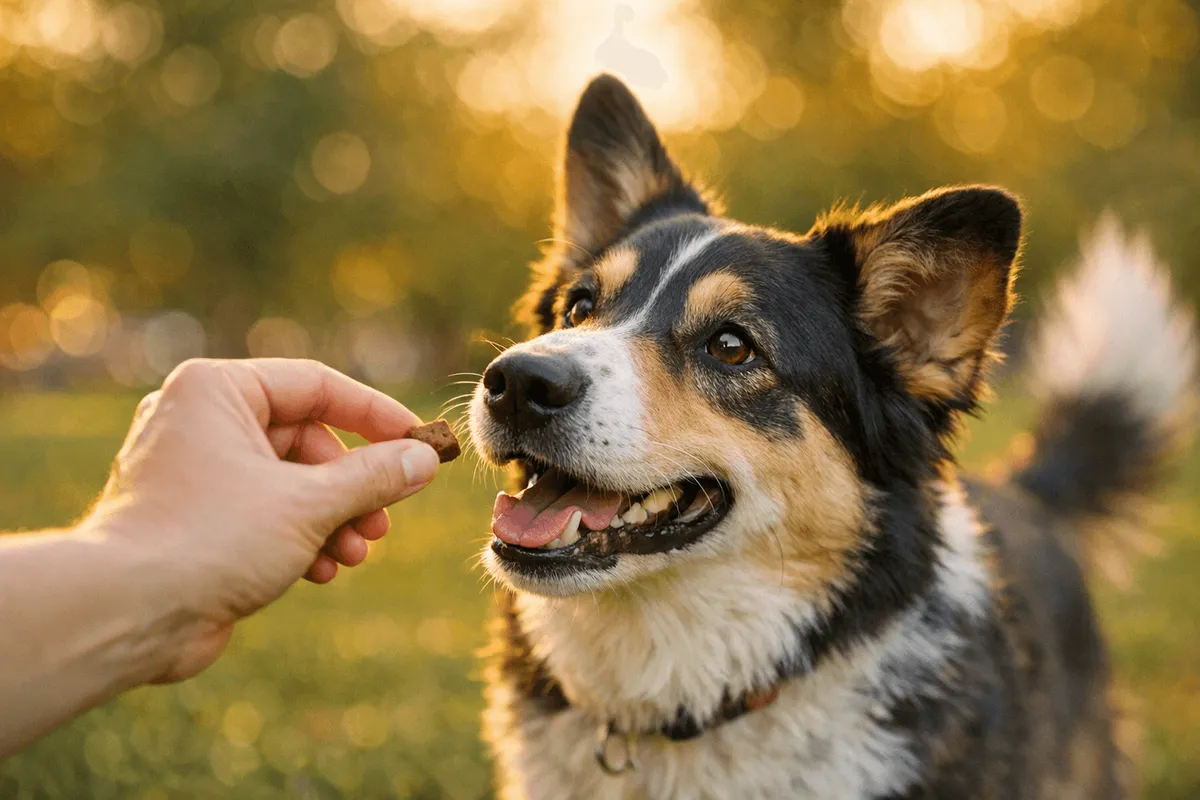
- Reward desired behaviors with treats, play, and praise
- Use management and redirection instead of punishment
- Understand that dogs repeat behaviors that are reinforced
- Backed by decades of behavioral science research
- Endorsed by the American Veterinary Society of Animal Behavior (AVSAB)
What the research says: A 2020 study published in the Journal of Veterinary Behavior found that dogs trained with aversive methods showed significantly more stress-related behaviors and were no more obedient than dogs trained with reward-based methods. Multiple studies confirm that punishment-based training increases fear and aggression.
Avoid trainers who:
- Talk about "dominance," "alpha," or "pack leader" dynamics — these are based on debunked wolf studies from the 1940s
- Use or recommend shock collars, prong collars, or choke chains as first-line tools
- Guarantee results — behavior is complex, and no ethical trainer promises a specific outcome
- Won't let you observe a session before committing
- Use phrases like "I fix dogs" — good trainers teach humans, who then work with their dogs
Experience with Your Specific Need
A trainer who's excellent with puppy socialization may not be the right choice for a dog with severe leash reactivity. Ask specifically about their experience with your situation:
- Puppy training — Socialization, bite inhibition, house training, basic manners
- Basic obedience — Sit, down, stay, come, loose-leash walking
- Behavior modification — Reactivity, resource guarding, separation anxiety, fear
- Sport training — Agility, rally, nose work, competitive obedience
For behavior issues (aggression, severe anxiety, phobias), look for a veterinary behaviorist (DACVB) or a certified behavior consultant (CAAB or IAABC) who works in collaboration with your vet.
Group Classes vs. Private Training
Both have their place. The right format depends on your dog's temperament and your goals.

Group Classes
Best for: Puppies, socialization, basic obedience, dogs who aren't reactive
| Pros | Cons |
|---|---|
| More affordable ($100–$200 for 4–6 weeks) | Less individual attention |
| Built-in socialization with other dogs | Not suitable for reactive or fearful dogs |
| Structured curriculum | Pace set by the group, not your dog |
| Fun social environment for you too | May need to wait for a new session to start |
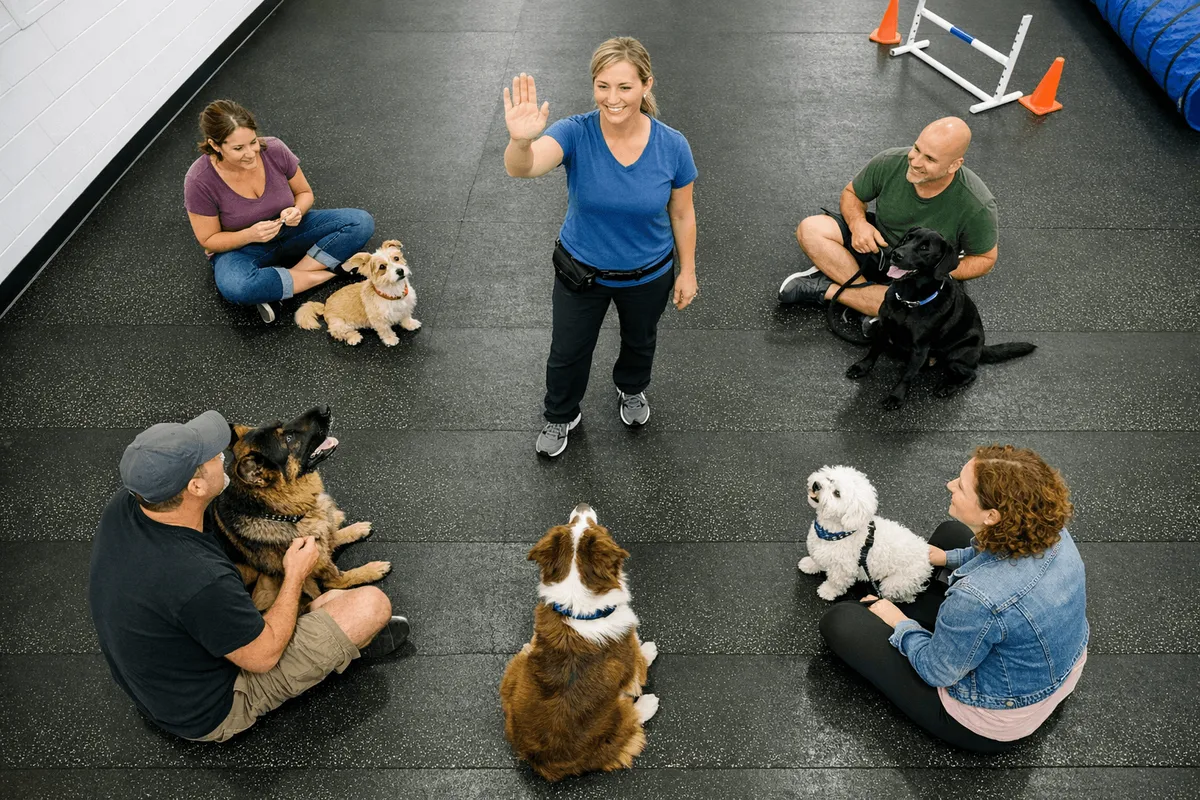
What to look for: Small class sizes (6–8 dogs max), an assistant trainer for support, and a controlled environment with enough space between dogs.
Private Training
Best for: Behavior problems, reactive dogs, busy schedules, specific goals
| Pros | Cons |
|---|---|
| Customized to your dog's exact needs | More expensive ($75–$200/session) |
| Flexible scheduling | No built-in socialization |
| Can address behavior issues in your home | Requires more self-discipline for homework |
| Trainer's full attention | Progress depends heavily on owner follow-through |
Pro tip: Many trainers offer a hybrid approach — start with private sessions to address the core issue, then transition to group classes for socialization and maintenance. This is often the best value.
Questions to Ask Before You Hire
Use these questions in your initial consultation (most good trainers offer a free or low-cost phone/video consult):
- "What certifications do you hold?" — Look for CPDT-KA, KPA CTP, or IAABC at minimum.
- "What training methods do you use?" — Listen for positive reinforcement, reward-based, and force-free. Be wary of "balanced" training, which often means punishment is on the table.
- "Can I observe a class or session?" — Any trainer who says no is a red flag. You should see their methods in action before your dog is involved.
- "What happens when a dog gets it wrong?" — The answer should involve redirection, management, or rethinking the approach — not corrections, leash pops, or escalation.
- "How do you handle a dog's specific issue?" — Listen for a thoughtful, individualized response. Cookie-cutter answers suggest limited experience.
- "What should I expect in terms of timeline?" — Ethical trainers give ranges and explain that progress depends on consistency. They don't promise "fixed in 3 sessions."
- "Do you have references I can contact?" — Especially from clients with similar issues to yours.
- "What's your continuing education?" — The field of animal behavior is evolving. Good trainers attend conferences, take courses, and stay current.
Red Flags to Walk Away From
Not every red flag is obvious. Here are the ones that matter most:
- No credentials or education listed — If they can't tell you where they studied, they probably didn't.
- "I've been doing this for 20 years" as the only qualification — Experience without education often means 20 years of repeating the same outdated methods.
- Blaming the dog — "He's dominant," "She's stubborn," "He knows what he did." These statements reveal a fundamental misunderstanding of dog behavior.
- Guarantees — "I guarantee your dog will be off-leash reliable in 4 weeks." Behavior doesn't work like that.
- No willingness to explain — A good trainer educates you. If they can't explain why they're doing something, they may not understand it themselves.
- Board-and-train programs with no transparency — If you can't visit, can't see video of sessions, and don't know what methods are used, your dog is at risk. Board-and-train can work, but only with full transparency.
- Immediate use of aversive tools — If a shock collar or prong collar comes out in the first session, leave. These tools should never be a starting point, and many qualified professionals never use them at all.
How to Set Your Dog Up for Success
Once you've chosen a trainer, your job has just begun. Training happens in the sessions — but learning happens at home.
- Do your homework. Practice the exercises daily, even for just 5–10 minutes. Consistency beats intensity.
- Keep a training journal. Note what works, what doesn't, and what triggers setbacks. Share this with your trainer.
- Be patient. Behavior change takes weeks to months, not days. Plateaus are normal.
- Get the whole household on board. Mixed signals from family members undo training fast. Everyone needs to use the same cues and rules.
- Communicate with your trainer. If something isn't working or doesn't feel right, speak up. A good trainer will adjust their approach.
The Bottom Line
The right dog trainer will make you a better dog owner. They'll help you understand why your dog does what they do, give you clear tools to shape the behavior you want, and build your confidence as a team.
Take the time to vet your trainer the way you'd vet a doctor or a mechanic. Ask questions, observe sessions, check credentials, and trust your gut. If something feels off — if the methods seem harsh, the explanations are vague, or your dog seems stressed — it's okay to walk away and keep looking.
Your dog deserves a trainer who sees them as a learner, not a problem to fix. And you deserve a trainer who teaches you, not just tells you what to do.
Frequently asked questions
How much does a dog trainer cost?
Group obedience classes run $150–$300 for a six-week course. Private in-home sessions are $75–$150 an hour, and board-and-train programmes run $1,000–$3,500 for two to four weeks. Veterinary behaviourists charge $300–$500 for an initial consultation, which is appropriate for aggression or severe anxiety rather than basic obedience.
What certification should a dog trainer have?
CPDT-KA (Certification Council for Professional Dog Trainers) and KPA-CTP (Karen Pryor Academy) are the strongest general credentials. CBCC-KA indicates behaviour-consultant training for fear and aggression. For serious cases, a DACVB is a board-certified veterinary behaviourist — a veterinarian with a residency in behaviour. Membership of an association is not a certification.
Are group classes or private training better?
Group classes are better value and add real-world distraction and socialisation, which matters for puppies. Private training is better for a specific problem, a reactive or fearful dog who cannot cope in a group, or a schedule that will not accommodate a fixed weekly class. Many owners do both — a group class for foundations, private sessions for the specific issue.
How do I know if a dog trainer is good?
Ask to observe a class before enrolling. A good trainer says yes without hesitation. Watch the dogs rather than the trainer: they should be loose, engaged, and willingly participating. Then ask what the trainer does when a dog gets something wrong — the answer tells you more than any credential, because it reveals whether the method rests on teaching or on suppression.
What are red flags in a dog trainer?
Guaranteed results, refusal to let you watch a class or attend a board-and-train facility, dominance and alpha framing, prong or shock collars presented as a first resort, vagueness about methods, and no certification at all. Any one of these is reason enough to keep looking.
How long does dog training take?
A basic obedience course is six to eight weeks, but the course is the start rather than the finish. Reliable behaviour comes from short daily practice over months. Behaviour problems such as reactivity or separation anxiety are measured in months to a year of consistent work, and any trainer promising to resolve one in a session or two is selling suppression rather than change.
Is board-and-train worth it?
Sometimes, with heavy caveats. Your dog learns to respond to the trainer, not to you, so the handover sessions matter more than the training itself — a programme without substantial owner instruction at the end is not worth its price. Insist on touring the facility and seeing where dogs sleep. Anyone who will not show you is telling you something.